Writing a cozy mystery novel involves a clear progression from initial concept through publication, with each phase building on the previous one. This guide breaks down the entire process into manageable steps that take aspiring authors from their first draft through to a polished, publication-ready manuscript. The journey requires understanding both the creative elements unique to the cozy genre and the practical mechanics of completing a book project.

The cozy mystery genre has specific conventions that readers expect, from amateur sleuths to low-violence plots set in small communities. New authors benefit from understanding these genre requirements while developing their own creative vision. The process encompasses everything from clarifying the initial story concept to building believable characters and satisfying plot structures.
Success in writing a cozy mystery depends on establishing sustainable habits and following a structured approach. This includes developing effective outlining techniques, maintaining momentum through the drafting phase, and applying focused revision strategies. The final stages prepare the manuscript for submission to publishers or for independent publication, ensuring the book meets professional standards.
Clarifying Your Inspiration and Story Idea

Before diving into the actual writing process, a writer needs to understand what drives them to tell this particular story and ensure the idea has enough substance to sustain an entire novel. A clear premise gives the cozy mystery direction and purpose from the very first page.
Identifying Your Motivation for Writing
Understanding why someone wants to write their first novel helps maintain momentum through the challenging drafting process. Some writers feel compelled to share a specific message about community, justice, or human nature. Others want to create the kind of comforting escape they wish existed on bookshelves.
The motivation might stem from a love of a particular setting, like a charming bakery or seaside village. It could come from wanting to craft an amateur detective who represents an underrepresented demographic. Whatever the reason, identifying it early helps make decisions about plot, character, and tone throughout the writing process.
Writers should ask themselves what they hope readers will feel when closing the book. This answer often reveals the core motivation driving the project.
Selecting a Novel-Worthy Story Idea
Not every story idea can support a full-length cozy mystery. A single clever murder method or charming character trait won’t carry 60,000 to 80,000 words. The concept needs complexity, conflict, and room for investigation.
A novel-worthy idea contains these elements:
- A compelling central mystery with multiple suspects and credible motives
- An amateur sleuth with logical access to clues and witnesses
- A distinctive setting that enhances rather than distracts from the plot
- Personal stakes that give the protagonist reasons beyond curiosity to solve the crime
- Potential for series continuation if planning multiple books
The idea should spark numerous story possibilities, not just one scene or twist. Writers testing their story ideas can try explaining the concept to someone unfamiliar with the genre. If they struggle to describe what happens beyond the initial murder, the idea likely needs more development.
Developing Your Initial Premise
The premise combines the protagonist, the central conflict, and the stakes into a clear statement. For a cozy mystery, this means identifying who investigates, what crime occurred, and why solving it matters personally to the sleuth.
A strong premise for writing your first novel might read: “When a rival baker dies at the county fair, pastry chef Emma must clear her name before losing her business and reputation in her small town.” This statement establishes character, crime, and consequences.
The premise should hint at the cozy elements readers expect: an amateur detective, a contained community setting, and personal rather than professional stakes. It shouldn’t try to encompass every subplot or character, just the core narrative thread that guides the investigation from discovery to resolution.
Planning Your Cozy: Outlining and Structure
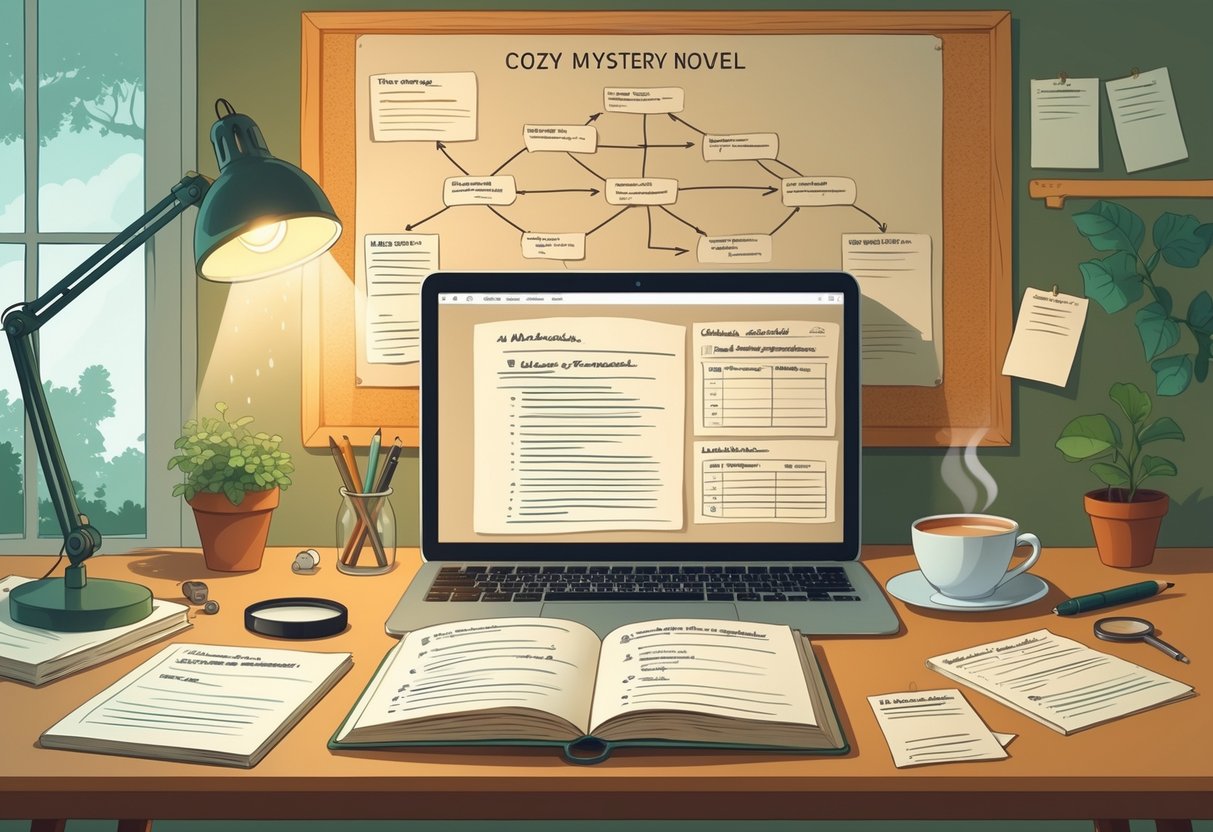
A solid outline transforms a scattered idea into a workable manuscript, while understanding structure and point of view ensures the story flows naturally from opening page to resolution.
Choosing Point of View and Tense
Most cozy mysteries use first-person POV in past tense, allowing readers direct access to the amateur sleuth’s thoughts and observations. This intimate perspective creates the conversational, engaging tone cozy readers expect. The protagonist narrates their discoveries, mistakes, and deductions in real time, building trust with the audience.
Third-person limited offers an alternative that maintains focus on the protagonist while providing slight distance. This POV works well for writers who want flexibility in describing the main character’s appearance or actions without the constraints of “I” narration. Past tense remains the standard choice, as it provides natural storytelling rhythm.
Writers should avoid head-hopping between multiple character perspectives within scenes. Cozy readers prefer staying grounded in one viewpoint, typically the amateur detective’s. Present tense appears occasionally in modern cozies but requires careful execution to avoid feeling gimmicky. The key is selecting a POV and tense combination early and maintaining consistency throughout the manuscript.
Utilizing Three-Act Structure
The three-act structure provides the framework for pacing a cozy mystery effectively. Act One (roughly 25% of the book) introduces the protagonist’s ordinary world, establishes the setting and supporting cast, then ends with the murder that disrupts everything.
Act Two (approximately 50% of the book) follows the protagonist’s investigation. This section includes:
- Interviewing suspects and gathering clues
- Discovering red herrings and false leads
- Experiencing setbacks or warnings from authorities
- Facing a midpoint revelation that shifts the investigation
- Hitting a low point where the solution seems impossible
Act Three (final 25%) brings the climax and resolution. The protagonist pieces together the final clues, confronts the killer in a dramatic reveal scene, and returns to a restored (but changed) normal life.
Building a Strong Outline
A functional outline for a cozy mystery should map out the major plot points without restricting creative flexibility during drafting. Writers can choose from several approaches based on their working style.
The scene-by-scene method lists each chapter’s key events, clues revealed, and character interactions. This detailed approach helps track red herrings and ensure proper clue placement throughout the manuscript. A spreadsheet or dedicated outlining software keeps this information organized.
The milestone method identifies only the crucial turning points: the murder, major clue discoveries, the midpoint twist, the dark moment, and the final confrontation. This looser framework suits writers who prefer discovering character voices and subplots while drafting.
Every outline should track the clue trail—what the protagonist learns, when they learn it, and how it connects to the solution. A separate list of red herrings ensures the mystery maintains complexity without becoming convoluted. Character arcs for the sleuth and key supporting players deserve outline attention, as cozy readers return for characters as much as mysteries.
Crafting Compelling Characters
Cozy mystery readers form strong attachments to protagonists who feel like friends, making character development essential for series success. The protagonist needs distinct traits and flaws, while supporting characters create the warm community atmosphere that defines the genre.
Developing Your Protagonist
The protagonist in a cozy mystery should be relatable and likable without being perfect. Amateur sleuths work best when they have a clear reason to investigate—a professional connection, personal stake, or strong curiosity that drives them into dangerous situations naturally.
Physical details matter less than personality traits and quirks. A bookstore owner who alphabetizes her spices, a baker who talks to her sourdough starter, or a librarian who cannot resist correcting grammar creates memorable, distinctive characters. These specific habits make protagonists feel real.
The protagonist needs vulnerabilities and limitations. She might be brilliant at solving puzzles but terrible at romantic relationships. He could be brave when protecting others but fearful of commitment. These contradictions create depth and prevent the character from seeming one-dimensional.
Essential protagonist elements:
- Specific occupation or role in the community
- Clear motivation for solving mysteries
- Distinctive voice and personality quirks
- Personal flaws that create obstacles
- Skills relevant to investigation
Creating Memorable Character Arcs
Character arcs in cozy mysteries differ from traditional thrillers because growth happens gradually across multiple books. The first novel establishes the protagonist’s initial state—perhaps grieving, starting over, or hiding from a past mistake.
Each mystery should challenge the protagonist in ways that force small changes. She might learn to trust others after years of isolation. He could gain confidence in his abilities despite initial self-doubt. These shifts must feel earned through the events of the story rather than appearing suddenly.
The arc balances consistency with growth. Readers expect familiar traits—the protagonist’s sense of humor, core values, and investigation style—while watching her evolve in specific areas. A character who begins the series avoiding commitment might slowly open herself to friendship, then romance, over subsequent books.
Avoid dramatic personality overhauls. Cozy readers want to spend time with characters they know and love, not witness complete transformations that make the protagonist unrecognizable.
Supporting Cast and Relationships
The supporting cast creates the cozy community that readers return to with each book. These characters need distinct personalities, speech patterns, and roles within the story. A gossipy neighbor, stern law enforcement officer, and quirky best friend form the foundation of most cozy series.
Relationships provide opportunities for conflict and growth without violence. The protagonist might clash with a family member over investigation methods, develop romantic tension with a local detective, or build friendships with other shopkeepers. These connections create stakes beyond solving the murder.
Each supporting character should serve a purpose beyond filling space. The best friend offers emotional support and helps with investigation. The love interest provides romantic tension and sometimes creates obstacles. The antagonistic character generates conflict and suspects.
Key relationship dynamics:
- Mentor figure who offers guidance or information
- Romantic interest with complications or slow-burn tension
- Best friend who provides support and comic relief
- Family members who create personal stakes
- Recurring suspects or antagonists who challenge the protagonist
Secondary characters can evolve across books but should maintain core traits. The grumpy detective who secretly respects the protagonist’s skills creates ongoing tension while allowing gradual friendship to develop.
Establishing Your Writing Process
A cozy mystery manuscript typically ranges from 60,000 to 80,000 words, requiring consistent effort over weeks or months. Writers who establish clear goals and routines complete their first drafts more reliably than those who write only when inspiration strikes.
Setting Achievable Word Count Goals
Starting with a daily word count goal of 500-1,000 words allows most writers to complete a first draft in two to three months without burnout. New writers often set unrealistic targets of 2,000+ words per day, leading to frustration when life interrupts this pace.
The math is straightforward. A 70,000-word manuscript divided by 500 words per day equals 140 writing days. At five days per week, that’s roughly 28 weeks to completion.
Writers should adjust their word count goal based on available time and personal writing speed. Some writers produce 300 polished words per hour, while others draft 1,000 words in the same timeframe. Testing different targets for a week reveals what feels sustainable.
Key considerations for goal setting:
- Track actual output for one week before committing to a number
- Count all words written, even if deleted later during revision
- Adjust goals during high-stress life periods rather than abandoning the project
- Focus on consistency over daily totals
Designing a Sustainable Writing Routine
A writing routine succeeds when it fits naturally into existing schedules rather than requiring complete lifestyle overhauls. Writers with full-time jobs often write before work, during lunch breaks, or in 30-minute evening sessions.
The writing process thrives on repetition. Writing at the same time and place each day trains the brain to enter creative mode more quickly. This applies whether a writer prefers early morning sessions at the kitchen table or late-night work in a home office.
Protecting scheduled writing time from interruptions matters more than the time slot chosen. Successful routines include turning off phone notifications, using website blockers, or writing in locations away from household distractions.
Elements of an effective writing routine:
| Element | Purpose |
|---|---|
| Consistent schedule | Builds writing habit through repetition |
| Dedicated space | Creates mental association with creative work |
| Minimal distractions | Maintains focus during limited writing windows |
| Warm-up ritual | Signals transition into writing mindset |
Overcoming Writer’s Block and Staying Motivated
Writer’s block in a first draft often stems from perfectionism rather than lack of ideas. The internal editor critiques every sentence, slowing progress to a halt. Writers who give themselves permission to write badly complete drafts faster.
When stuck on a scene, writing “[FIGURE THIS OUT LATER]” and moving forward maintains momentum. The first draft exists to tell the story from beginning to end, not to achieve publication quality.
Motivation naturally fluctuates during a multi-month writing process. Tracking progress visually through spreadsheets or progress bars provides concrete evidence of advancement during discouraging days. Some writers reward themselves after completing each chapter or reaching word count milestones.
Connecting with other cozy mystery writers through online communities or writing groups combats isolation. Sharing weekly progress creates gentle accountability without harsh judgment.
Practical strategies for maintaining momentum:
- Skip difficult scenes and return to them later
- Reread the previous day’s work to regain story flow
- Set a timer for 15 minutes and write without stopping
- Change writing location when usual space feels stale
- Review the story’s “why” from initial planning stages
Completing the First Draft
The first draft transforms a cozy mystery concept into a tangible manuscript through consistent writing practices and strategic problem-solving. Writers who understand efficient drafting methods and anticipate common obstacles complete their manuscripts with greater confidence and momentum.
Drafting Techniques for Efficiency
Setting daily word count targets creates measurable progress and builds writing momentum. Most cozy mystery writers aim for 500-1,000 words per day, which translates to a complete first draft in 2-3 months. These targets should remain flexible enough to accommodate real life while maintaining forward progress.
Writing out of order helps writers capitalize on their current creative energy. If a climactic confrontation scene feels more accessible than the next chronological chapter, drafting it immediately preserves that inspiration. The manuscript can be assembled into proper sequence during revision.
Silencing the internal editor during first draft work prevents perfectionism from stalling progress. Writers should resist the urge to revise earlier chapters before completing the full manuscript. Placeholder text like “[add description here]” or “[fix this dialogue later]” keeps the draft moving forward.
Time-blocking specific writing sessions protects drafting time from competing obligations. Whether 30 minutes before work or two hours on weekends, dedicated blocks create routine and reduce decision fatigue about when to write.
Plot holes and inconsistencies naturally emerge during first draft writing and should be noted without interrupting forward progress. Writers can maintain a separate document to track these issues—contradictory clues, timeline problems, or character details that shifted mid-draft—for resolution during revision.
Character voice drift occurs when protagonists or suspects sound different in chapter twenty than chapter three. This challenge resolves itself through revision once writers fully understand their characters. The first draft serves as character discovery.
Sagging middle sections plague most cozy mystery manuscripts when the initial setup concludes but the climax remains distant. Writers should introduce a new suspect, reveal an unexpected clue, or create interpersonal conflict among recurring characters to maintain narrative tension.
Self-doubt and motivation dips threaten manuscript completion more than technical writing challenges. Setting minimum word counts (even 100 words counts as progress), joining accountability groups, or rewarding milestone achievements helps writers push through resistance and reach “The End.”
Revising and Polishing Your Manuscript
Completing a first draft of a cozy mystery marks a significant milestone, but the real transformation happens during revision. A strong self-editing process, combined with external feedback and professional guidance, turns raw material into a polished manuscript ready for submission.
Self-Editing Strategies
Writers should wait at least two weeks after finishing their draft before beginning revisions. This break allows them to approach the manuscript with fresh perspective and identify issues they previously overlooked.
The first pass should focus on structural elements. Writers need to verify that clues appear at appropriate intervals, red herrings mislead without confusing readers, and the mystery solution feels both surprising and inevitable. They should check that the amateur sleuth’s motivations remain clear and that secondary characters serve distinct purposes in the plot.
The second pass addresses pacing and scene work. Cozy mysteries typically maintain a lighter tone even during tense moments, so writers should ensure dialogue sounds natural and reflects each character’s personality. They should eliminate unnecessary scenes that don’t advance the plot or deepen character relationships.
The final self-edit focuses on line-level improvements. Writers should remove redundant phrases, replace weak verbs with stronger alternatives, and ensure consistent verb tenses throughout. Reading passages aloud helps identify awkward phrasing and rhythm issues.
Seeking Feedback from Beta Readers
Beta readers provide valuable insights into how the mystery unfolds for actual readers. Writers should select three to five beta readers who regularly enjoy cozy mysteries and understand genre conventions.
Effective beta reader recruitment involves clear communication about expectations. Writers should specify whether they want feedback on plot holes, character development, pacing, or all aspects of the manuscript. They should provide a reasonable deadline, typically four to six weeks for a full-length novel.
When receiving feedback, writers should look for patterns in comments. If multiple beta readers mention the same issue—such as a confusing timeline or an unlikeable protagonist—the problem likely needs addressing. Writers should remain open to criticism while recognizing that not every suggestion requires implementation. Beta reader feedback works best when writers ask specific questions about areas of concern, such as whether the murderer’s identity was too obvious or if the cozy community felt authentic.
Hiring a Professional Editor
Professional editors bring expertise that elevates manuscripts beyond what self-editing and beta readers can achieve. For cozy mysteries, writers should seek editors with experience in the genre who understand reader expectations for amateur sleuths, small-town settings, and appropriate violence levels.
Three types of editing serve different purposes. Developmental editors address big-picture issues like plot structure, character arcs, and pacing. Copy editors focus on grammar, punctuation, consistency, and style. Proofreaders catch remaining typos and formatting errors before publication.
Writers working with traditional publishers will receive editorial support, but those pursuing independent publishing must budget for these services. Developmental editing typically costs between $0.03 and $0.08 per word, while copy editing ranges from $0.02 to $0.04 per word. Writers should request sample edits from potential editors to ensure compatible working styles and verify the editor’s familiarity with cozy mystery conventions.
Preparing for Publication
Once the cozy mystery manuscript reaches its final form, authors face critical decisions about publishing paths and submission requirements. These choices shape everything from creative control to distribution reach.
Understanding Traditional and Self-Publishing Options
Traditional publishing requires authors to submit their manuscript to literary agents or publishers who handle editing, cover design, distribution, and marketing. This path offers professional expertise and established distribution channels but means less creative control and longer timelines. Authors typically receive advances and royalties but must meet specific submission guidelines.
Self-publishing grants complete control over the manuscript, cover design, pricing, and release schedule. Authors use platforms like Amazon KDP, IngramSpark, or Draft2Digital to distribute their cozy mystery in multiple formats. This route demands personal investment in professional editing, cover design, and marketing efforts.
Hybrid publishing combines elements of both models. Authors retain creative control while accessing professional services for editing, design, and distribution. This option often requires upfront costs but allows faster publication than traditional routes.
Finalizing Your Manuscript for Submission
The manuscript must undergo professional editing before submission or publication. Developmental editing addresses plot structure, pacing, and character development in the cozy mystery. Copyediting corrects grammar, punctuation, and consistency issues. Proofreading catches final errors before publication.
Traditional publishers require specific formatting guidelines for manuscript submissions. Standard requirements include double-spaced text, 12-point Times New Roman or similar fonts, one-inch margins, and proper chapter formatting.
Self-publishing authors must format their manuscript for each distribution platform. Different retailers require specific file types like EPUB for ebooks or PDF for print versions. The manuscript needs proper front matter including title page, copyright information, and dedication pages. Back matter should include author biography and links to future books in the series.